
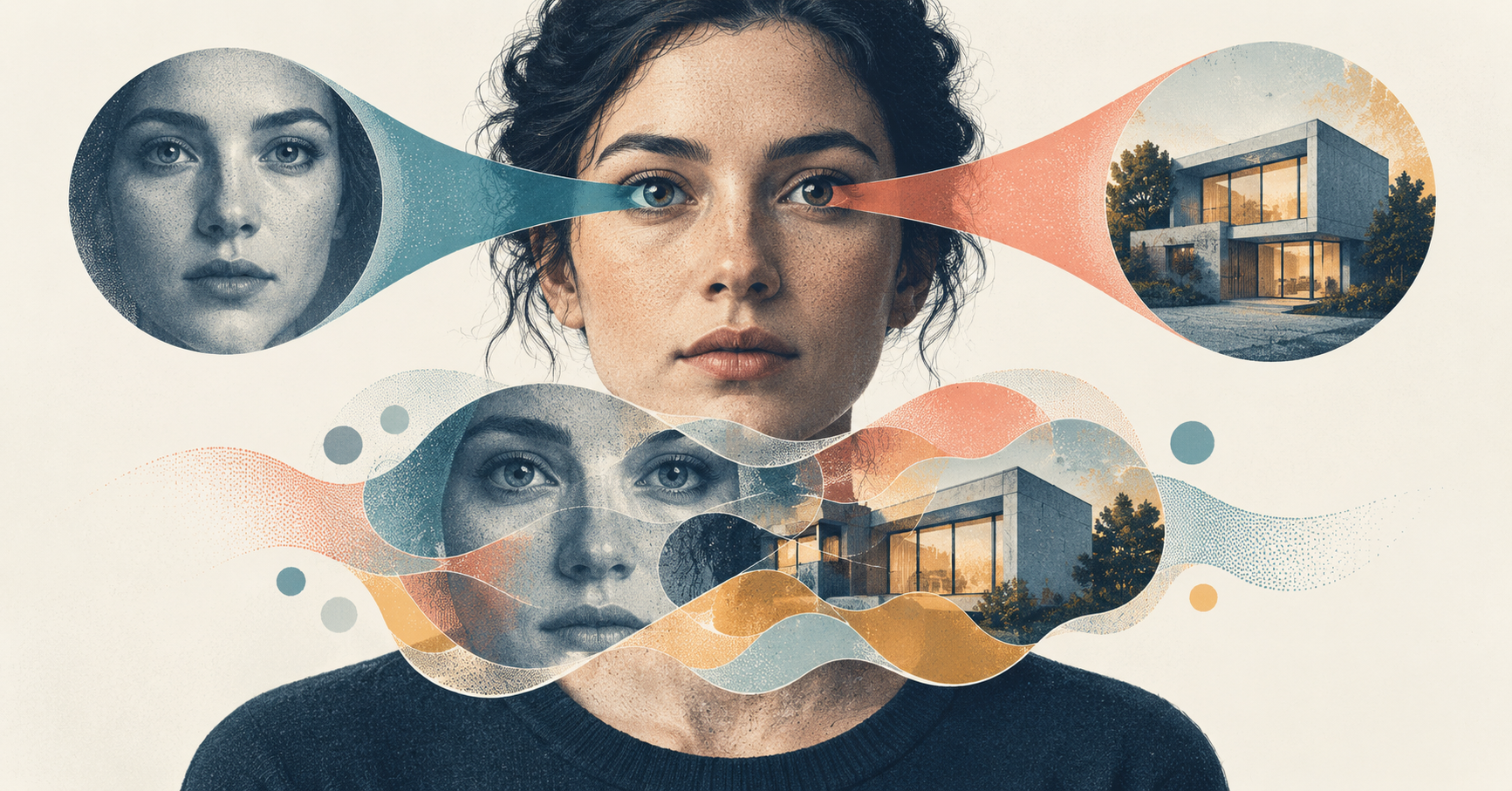
What if nothing in front of your eyes changed, but what you consciously saw kept changing?
This is precisely what happens during binocular rivalry.
In the laboratory, we present one image to the left eye and a very different image to the right—for example, a face to one eye and a house to the other. Because the visual system cannot easily combine these incompatible images into a single coherent percept, conscious perception begins to alternate. For a few seconds, you may see the face. Then the house takes over. Later, the face returns.
The images presented to your eyes have not changed. Your conscious experience has. This striking dissociation has made binocular rivalry one of the most useful experimental tools for studying visual consciousness.
Two eyes, two incompatible realities
In everyday vision, the two eyes receive slightly different views of the same world. The brain usually combines them effortlessly. Indeed, the small differences between the two retinal images help us perceive depth.
Binocular rivalry disrupts this normal arrangement. When the images shown to the two eyes are sufficiently incompatible, the visual system cannot fully fuse them. Rather than representing both inputs equally, perception becomes unstable: one image dominates awareness while the other is suppressed. A few moments later, their roles may reverse.
What makes this phenomenon especially important is not simply that perception alternates. It is that perception alternates while the physical stimulus remains unchanged.
Why does this matter for consciousness research?
There is a fundamental difficulty in studying consciousness experimentally. When something in visual experience changes, something in the external world has usually changed as well.
A light turns on. A person enters the room. An object moves.
The sensory input, neural activity and conscious experience all change at roughly the same time. This makes it difficult to determine which neural changes are specifically associated with the change in conscious experience.
Binocular rivalry offers a partial way around this problem. The physical images can remain constant while the observer’s conscious experience changes spontaneously. Researchers can therefore compare periods in which the visual stimulation is unchanged but conscious perception differs.
This does not make binocular rivalry a pure measure of consciousness. Attention, neural adaptation, eye movements, perceptual decisions and the act of reporting what one sees can all influence experimental findings. Nevertheless, binocular rivalry provides something unusually valuable: a dissociation between what is presented to the eyes and what is consciously experienced.
Seeing is not simply recording
Binocular rivalry also reveals something fundamental about ordinary perception. We often imagine vision as though the brain were a camera: light reaches the eyes, the brain processes it, and consciousness simply displays the resulting image.
But perception does not work like a photograph.
The brain continuously selects, organises and interprets sensory information. Under normal conditions, these processes are so successful that the constructed nature of perception remains largely invisible.
Binocular rivalry makes it difficult to ignore. The visual input remains unchanged, yet the content of consciousness continually reorganises itself. The source of this change must therefore lie, at least partly, in the dynamics of the perceptual system itself.
This is one reason I find binocular rivalry so compelling: it makes the gap between physical stimulation and subjective experience experimentally visible.
Perception does not simply switch from A to B
Textbook illustrations of binocular rivalry often suggest a neat sequence:
face → house → face → house
Actual experience is much less tidy.
During transitions, observers may briefly see parts of both images. One percept may spread gradually across the visual field. The two images may appear superimposed, or different regions of the visual field may be dominated by different images at the same moment.
These intermediate experiences are not merely noise between two stable perceptual states. They may tell us something important about how perceptual representations compete—and how one conscious state gives way to another.
This was one of the central questions behind my own research. Rather than assuming in advance that observers experience only a small number of predefined transition types, we asked participants to describe and draw what they actually saw.
We identified 20 distinct categories of perceptual transitions. Individual observers typically experienced several different forms, and their characteristic patterns were relatively consistent over time. These findings suggest that binocular rivalry is not simply a competition between two discrete percepts.
There is a much richer perceptual landscape in between.
This also has an important methodological consequence: if we reduce subjective experience to two buttons—“image A” and “image B”—we may discard meaningful information before the analysis even begins.
What shapes the richness of perceptual experience?
When we examined not only when perception changed but also what the transition looked like, we found that contrast and attention affected different forms of perceptual transition in different ways.
Changes in stimulus contrast influenced certain gradual, spatially extended transitions, whereas attention particularly affected immediate switches between percepts. This illustrates a broader problem in experimental psychology and neuroscience: two mechanisms may appear similar when measured using a coarse outcome variable. Their differences become visible only when experience is measured in greater detail.
Our qualitative approach also revealed that age-related changes in binocular-rivalry transitions were not uniform. Instead, they depended on the stimuli being viewed. That distinction matters. Two groups may produce similar values on a conventional quantitative measure while nevertheless having meaningfully different perceptual experiences.
If we measure only how long a percept lasts, we may miss changes in the structure of experience itself.
What, then, does binocular rivalry teach us about consciousness?
Binocular rivalry does not solve the problem of consciousness. It does not explain why neural processing gives rise to subjective experience, nor can it provide a complete theory of consciousness on its own.
What it offers is an unusually clear experimental window onto several important questions:
- How does one perceptual representation gain access to awareness while another is suppressed?
- Why does a percept remain stable for a few seconds and then disappear?
- How do attention, stimulus properties, age and individual differences shape what becomes consciously visible?
- How can the same physical input produce different conscious experiences at different moments?
Binocular rivalry reminds us that consciousness is not simply the final frame produced by a camera pointed at the external world. What we experience depends on the dynamics of the system doing the seeing. Most of the time, those dynamics remain hidden behind the apparent stability of perception. Binocular rivalry brings them into view.
Further reading
Yilmaz, C., Pabel, L., Kerschenbauer, E., Ischebeck, A., Sipatchin, A., Bartels, A., & Zaretskaya, N. (2025). The complexity of human subjective experience during binocular rivalry. Neuroscience of Consciousness.
Yilmaz, C., Maitz, K., Gerschütz, M., Grassegger, W., Ischebeck, A., Bartels, A., & Zaretskaya, N. (2026). Differential effects of attention and contrast on transition appearance during binocular rivalry. Journal of Vision.
Yilmaz, C., Jellen, T., Gerschütz, M., Bartels, A., & Zaretskaya, N. (2026). Qualitative changes in binocular rivalry experience with age. Scientific Reports.