Phenomenology of Transitions in Binocular Rivalry
My doctoral research revealed how our consciousness can resolve the conflict of two pieces of visual input simultaneously presented to two eyes. When this happens, our brain combines two different visual inputs in various ways. What we present (such as simple lines, images, or dots moving coherently) affects how two visual inputs are combined. There is also an individual difference in the combining type. The subject’s age and attentional state contribute to this difference.
- Supervisor: Assoc. Prof. Dr. Natalia Zaretskaya
- Period: 09/2020 – Present
Tools & Libraries
- RStudio: stats, nlme, lme4, afex, emmeans, ggplot2, ggpubr
- Psychtoolbox on MATLAB for stimulus presentation and behavioral recording
- R Markdown for reproducible analysis
Info-Box
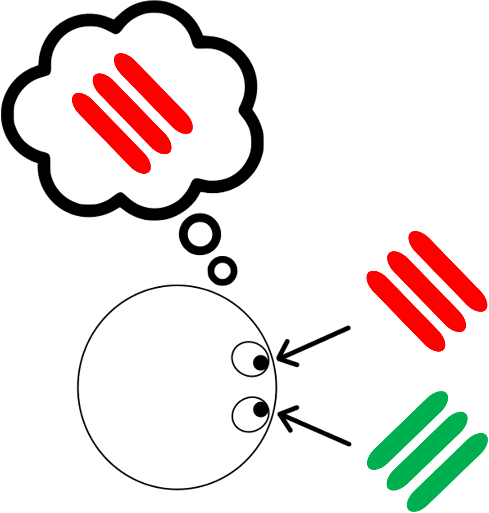
Binocular rivalry occurs when two eyes are presented with two different images that cannot be fused into a uniform perception. As a result, the subject’s perception alternates between the dominant image of either of the presentations with a transition phase.
Research Questions
- How many different appearances can observers perceive during conflicting visual stimulation, i.e., binocular rivalry?
- Are the appearances consistent over time?
- How does the contrast of stimuli influence the appearance?
- How does the attentional state affect the appearance?
- Does the observer’s age affect the transition appearance?
Objective: Understand the dynamics of conscious visual perception using behavioral data.
Experiment 1: Categorizing qualitative descriptions & Age effect
Different visual stimuli were presented to the participants. After that, they described what they perceived during the experiment verbally and with a simple sketch. Then, my colleagues and I categorized these descriptions.
125 participants (18-65 years)
Binocular rivalry (BR) paradigm
Stimulus types:
- GG: gratings with an orientation of ± 45 degrees
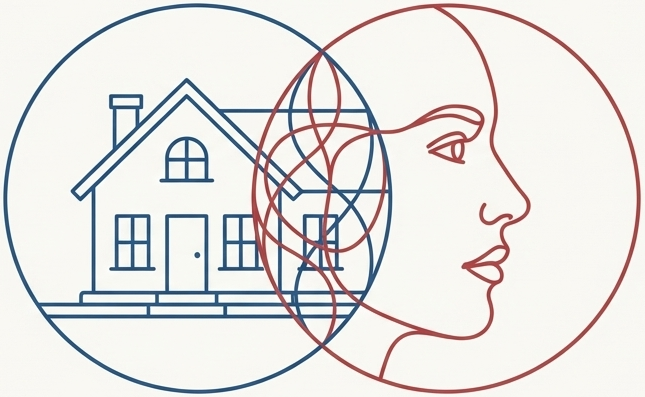
- II: images of a house and a face
- DD: dots moving coherently
- GI: grating and image
- DI: moving dots and image
- DG: moving dots and grating
Task: Press a button to report an exclusive percept
Experiment 2: Contrast & Attention effect
Again, the participants were presented with different stimuli. They pressed one of four buttons to report their perception: overlaid stimuli, a mosaic of stimuli, opening the curtain, or an immediate switch between two stimuli. The contrast of stimuli and the participant’s attention were manipulated during the experiments. Then, I analyzed the effect of manipulations on the duration and relative frequency of specific appearances.
79 participants (18-40 years)
Binocular rivalry (BR) paradigm
Stimulus types:
- GG: gratings with an orientation of ± 45 degrees
- II: images of a house anda face
- DD: dots moving coherently
Task: Press a button to report transition type: superimposed, piecemeal, travelling wave, or immediate
Methods & Results
Analysis of behavioral data
→ Preprocessing (cleaning irrelavant keys, removing outliers)
→ Linear mixed model (LMM) for BR parameters
→ Cochran's Q test (categorical ANOVA)
→ Visualization of transition reports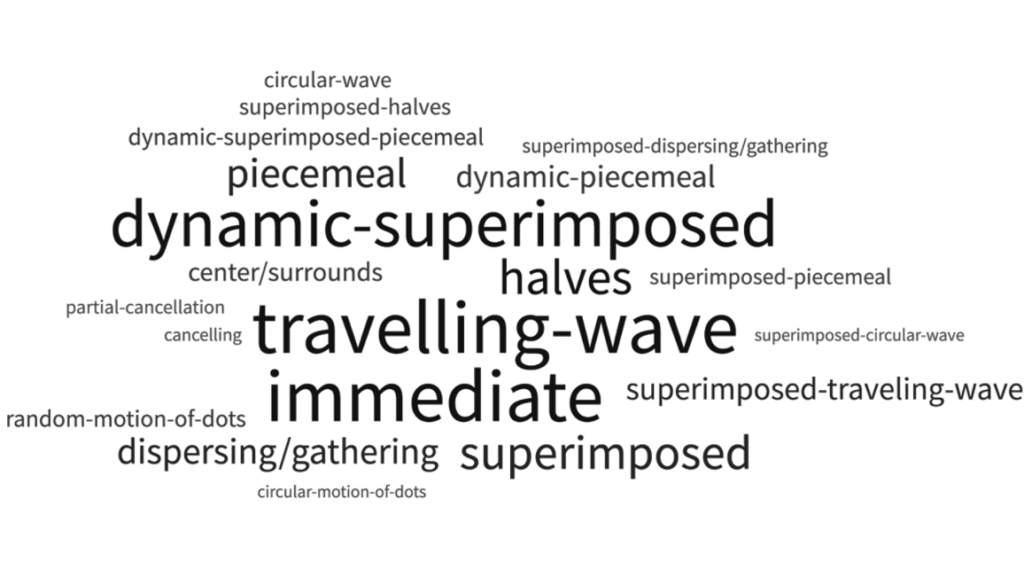
Findings:
- 20 categories of appearance
- Significant effect of information type
- Consistency of types over time
- Significant individual difference
- Decline of some categories with age
- Similar quantitative but different qualitative effects of contrast & attention
Outcome & Impact
This research project focuses on the phenomenology and dynamics of conscious visual perception. I explored how perceptual states emerge, how they are experienced subjectively, and how they are influenced by factors such as the observer’s age, attention, and stimulus contrast.
This line of work contributes to a growing shift in consciousness research—from merely correlating perception with physical stimuli toward examining how experience itself unfolds over time. By quantifying subtle aspects of subjective perceptions, my studies help to characterize conscious perception as a continuous, temporally structured process rather than a series of discrete states.
Together, my publications in Neuroscience of Consciousness and Journal of Vision, and my preprint in PsyArXiv, highlight the value of combining rigorous behavioral experimentation with careful phenomenological analysis. They advance an empirical approach to consciousness that respects both the measurable and the experiential dimensions of perception.
Publications
Journal of Vision
Yilmaz, C., Maitz, K., Gerschütz, M., Grassegger, W., Ischebeck, A., Bartels, A., and Zaretskaya, N. (2026). Differential effects of attention and contrast on transition appearance during binocular rivalry. Journal of Vision 26(14). DOI: 10.1167/jov.26.1.14
Neuroscience of Consciousness
Yilmaz, C., Pabel, L., Kerschenbauer, E., Ischebeck, A. Sipatchin, A., Bartels, A. and Zaretskaya, N. (2025). The complexity of human subjective experience during binocular rivalry. Neuroscience of Consciousness. DOI: 10.1093/nc/niaf004
Public talk
3 Minute Thesis Competition, 15.03.2024, Graz, Austria. Video
Conference talks
53rd DGPs Congress/15th ÖGP Conference, 16.09.2024, Vienna, Austria. https://dgps2024.univie.ac.at/home-news/
Trieste Symposium on Perception and Cognition, 27.10.2023, Trieste, Italy. https://sites.units.it//bernardis/symposium2023.html
Poster presentation
European Conference on Visual Perception (ECVP), 30.08.2023, Paphos, Cyprus. Perception
Reproducible pipeline
Fully documented analysis notebooks available on GitHub & OSF
Yilmaz C, and Zaretskaya N. Top-down and bottom-up effects on the subjective experience during binocular rivalry [Dataset]. OSF, 2024. DOI: 10.17605/OSF.IO/FQYXB
Yilmaz C, and Zaretskaya N. The Complexity of Subjective Experience during Binocular Rivalry [Dataset]. OSF, 2024. DOI: 10.17605/OSF.IO/N6DQF
Yilmaz C. Behavioral Data Analysis Toolkit for Transitions in Binocular Rivalry [R Package]. GitHub, 2024. https://github.com/cemreyilmaz/transrivalry
Yilmaz C. R-based Preprocessing Tool for Binocular Rivalry Data [R Package]. GitHub, 2024. https://github.com/cemreyilmaz/preprivalry
Keywords: cognitive neuroscience, visual perception, binocular rivalry, psychophysics, data science